Bed Bug Heat Treatment for Full Eradication in One Visit
Bed bug infestations are among the most persistent and disruptive pest problems affecting homes, hotels, and commercial properties. These insects are highly adaptable, capable of hiding in microscopic cracks, furniture seams, and wall voids, making detection and elimination extremely challenging.
One of their most problematic traits is survival without feeding for extended periods, allowing infestations to remain dormant and re-emerge unexpectedly. This resilience is why traditional chemical treatments often require multiple visits and prolonged monitoring.
In contrast, professional heat treatment offers a highly advanced solution capable of achieving complete eradication in a single controlled intervention. By exposing all life stages of bed bugs, including eggs, to lethal temperatures, heat treatment eliminates the infestation at its root.
What Is Bed Bug Heat Treatment?
Bed bug heat treatment is a professional pest control method that uses precisely controlled thermal energy to eradicate bed bugs across all developmental stages: eggs, nymphs, and adults.
The process involves raising the temperature of an entire room or property to a sustained level that is lethal to bed bugs while remaining safe for structural integrity and most household contents.
Unlike chemical-based methods that rely on contact or ingestion, heat treatment works by penetrating deeply into hidden harbourages, including:
- Furniture seams and upholstery
- Wall voids and electrical voids
- Mattress interiors and bed frames
- Flooring gaps and skirting board cavities
- Soft furnishings and textiles
This ensures that no concealed population is left untreated.
How Heat Treatment Eliminates Bed Bugs
Bed bugs are highly sensitive to sustained heat exposure. Once exposed to critical temperatures, their physiological systems begin to fail due to protein denaturation and rapid dehydration.
T≥50∘CT \geq 50^\circ\text{C}
At or above this temperature threshold, bed bugs and their eggs cannot survive long enough to recover or adapt.
Key Advantages of Thermal Eradication:
- Immediate mortality across all life stages
- No development of chemical resistance
- Deep penetration into inaccessible harbourages
- Simultaneous eradication of the entire infestation
Because heat naturally disperses throughout enclosed environments, it reaches areas that conventional sprays and powders cannot effectively penetrate.
Why Bed Bugs Are So Difficult to Eradicate
Bed bugs are exceptionally difficult to eliminate due to a combination of biological and behavioural traits:
- They hide in extremely narrow and concealed spaces
- They are primarily nocturnal and avoid detection during daylight hours
- They can survive for extended periods without feeding
- Their eggs are resistant to many conventional insecticides
- They reproduce rapidly under favourable conditions
These factors allow infestations to persist even after partial or incorrectly targeted treatments, often leading to repeated reinfestation cycles.
What Happens During a Professional Heat Treatment
1. Initial Inspection and Preparation
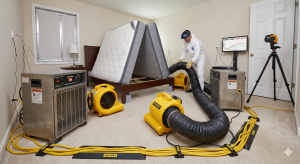
A detailed inspection is carried out to assess infestation severity and identify key hotspots. Furniture may be repositioned to allow optimal airflow and heat distribution.
2. Controlled Heating Process
Specialist industrial heating equipment is deployed to gradually increase ambient temperatures throughout the property. High-capacity air movers ensure uniform heat circulation across all rooms.
3. Temperature Monitoring
Multiple strategically placed sensors continuously monitor temperature levels to ensure lethal conditions are achieved and maintained across all affected zones.
4. Sustained Exposure Phase
Once target temperatures are reached, they are maintained for a sufficient duration to guarantee complete eradication of all bed bug life stages, including eggs in protected locations.
5. Cooling and Post-Treatment Verification
After treatment completion, the property is safely cooled. A post-treatment inspection confirms eradication success and ensures no surviving activity remains.
Advantages of Heat Treatment Over Chemical Methods
Heat treatment is widely regarded as one of the most effective modern solutions for bed bug control due to several key benefits:
- Potential for full eradication in a single visit
- No chemical residues left behind in living environments
- Highly effective against resistant infestations
- Immediate results without waiting for multiple treatment cycles
- Ability to penetrate hidden and inaccessible harbourages
Unlike chemical approaches, heat does not depend on insect behaviour such as feeding or surface contact, ensuring uniform exposure across the entire infestation.
Limitations and Considerations
Although highly effective, heat treatment must be carefully managed by trained professionals to ensure safety and optimal performance:
- Heat-sensitive electronics and materials require assessment
- Certain structural layouts may require pre-treatment preparation
- Adjacent untreated areas may require monitoring to prevent reinfestation
- Excessive clutter can reduce airflow and heat penetration efficiency
Proper preparation significantly improves treatment effectiveness and ensures consistent thermal distribution.
Signs You May Need Heat Treatment
Common indicators of a bed bug infestation include:
- Repeated unexplained bites, often in linear or clustered patterns
- Small blood stains on bedding or mattresses
- Dark faecal spotting on sheets, seams, or furniture edges
- A musty, sweet odour in heavily infested areas
- Visible live bed bugs in mattress seams or furniture joints
If infestations persist after chemical treatments, heat treatment is often the most reliable and definitive solution.
Why Heat Treatment Achieves Full Eradication in One Visit
Heat treatment is uniquely capable of delivering complete eradication in a single intervention because it addresses the entire infestation simultaneously rather than sequentially.
Key reasons include:
- Uniform heat distribution eliminates all harbourages at once
- Eggs are destroyed during the same treatment cycle as adults
- No residual survival pockets remain for recolonisation
- No reliance on baiting, ingestion, or behavioural exposure
This makes it particularly effective for widespread or severe infestations where traditional methods have failed.
Prevention After Treatment
Once eradication has been achieved, preventative measures are essential to avoid reinfestation:
- Inspect luggage, clothing, and second-hand furniture before bringing indoors
- Maintain regular vacuuming of sleeping and upholstered areas
- Use protective mattress and pillow encasements
- Reduce clutter to minimise potential hiding places
- Monitor for early signs of renewed activity
Early detection significantly reduces the risk of future infestations becoming established.
When to Call a Pest Control Professional
Professional intervention is strongly recommended when:
- Bed bugs persist after DIY or chemical treatments
- Infestation spreads across multiple rooms or floors
- Multiple hiding locations are suspected within structural voids
- Reproduction continues despite cleaning and control efforts
Heat treatment is most effective when implemented as part of a coordinated whole-property eradication strategy.
Conclusion
Bed bug heat treatment represents one of the most advanced and reliable pest control solutions available today. By using precisely controlled temperatures to eliminate all life stages simultaneously, it removes the limitations associated with chemical treatments and significantly reduces eradication time.
When performed by trained professionals, heat treatment offers a fast, comprehensive, and highly effective solution capable of resolving even severe infestations in a single visit, restoring full comfort and hygiene to the property.
Expert Tips & Guides to Prevent Pests After Heat Treatment in London
- Flies in Kitchens and Waste Areas (Drain and Hygiene-Related Infestations)
- Ant Pest Control for Recurring Indoor Infestations
- Bed Bug Heat Treatment for Full Eradication in One Visit
- Pest Survey Reports for Mortgage and Property Safety Checks
- Signs of Hidden Pest Infestations Behind Walls and Appliances
- Cockroach and Silverfish Infestations in Kitchens and Bathrooms
- Flea Infestations in Homes Without Pets
- Chemical-Free Treatments for Hidden Infestations