Chemical-Free Treatments for Hidden Infestations
Hidden pest infestations are among the most difficult to eliminate because pests often reside in inaccessible areas such as wall voids, flooring gaps, wardrobes, upholstery, and insulation. In many cases, traditional chemical treatments struggle to reach these concealed environments effectively.
Chemical-free pest control methods provide a modern alternative that focuses on physical elimination rather than relying on insecticides. Among these, heat treatment is one of the most effective solutions, particularly for stubborn infestations such as bed bugs and moths.
By using controlled temperatures to target all life stages of pests, including eggs, chemical-free treatments offer deep penetration and complete eradication potential without leaving chemical residues behind.
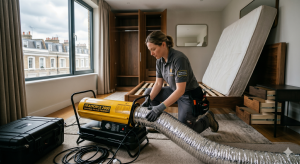
Hidden infestations are challenging because pests are not simply “present in a room” — they are distributed within the structure of the building itself. This creates a three-dimensional problem where activity occurs in inaccessible layers rather than on visible surfaces.
In practice, pests establish micro-colonies inside thermal, structural, and fabric-based voids where conditions remain stable and undisturbed. These environments act as protective buffers against conventional treatments.
Typical concealed harbourage zones include:
- Structural voids within walls and partition gaps
- Subfloor spaces beneath flooring systems
- Junctions behind skirting boards and architraves
- Internal cavities of upholstered furniture and bed frames
- Deep layers of carpets, underlay, and insulation
- Folded or stored textiles in wardrobes and storage units
What makes these areas particularly problematic is that they are not isolated pockets — they are often interconnected. This allows pests to move between zones, avoiding treated areas and re-establishing activity once conditions stabilise.
Another key difficulty is that many infestations are behaviourally adaptive. When exposed to disturbance or partial treatment, pests may:
- Relocate deeper into voids rather than surface areas
- Temporarily reduce activity, creating a false impression of success
- Split into smaller satellite clusters that are harder to detect
This is why surface-level intervention alone rarely achieves full elimination.
What Are Chemical-Free Pest Treatments?
Chemical-free pest control focuses on physical disruption of pest survival conditions rather than poisoning or chemically affecting the organism. The objective is to remove or alter the environmental factors required for life stages to continue.
Instead of targeting pests indirectly through ingestion or contact, these methods aim to create conditions where survival is no longer biologically possible.
Core categories of chemical-free control:
- Thermal intervention – raising or lowering temperature beyond survival thresholds
- Moisture and humidity control – removing conditions required for development and reproduction
- Mechanical extraction – physically removing pests and biological material
- Steam penetration systems – localised high-temperature application for fabric and surface treatment
- Structural exclusion techniques – sealing and blocking access routes to prevent recolonisation
Among these, thermal-based solutions are the most comprehensive because they address both visible and hidden populations simultaneously, including eggs and dormant stages that are otherwise resistant to conventional approaches.
Heat Treatment for Bed Bugs
Bed bugs present one of the most complex indoor pest challenges due to their ability to survive in extremely compressed spaces and remain inactive for long periods between feedings. Their biology makes them particularly resistant to fragmented or partial treatment approaches.
How Heat Treatment Works in Practice
Instead of targeting pests individually, heat treatment alters the entire environmental condition of the structure.
Once ambient temperatures are elevated beyond biological tolerance levels, proteins within the pest’s body begin to denature, leading to irreversible system failure.
T≥50∘CT \ge 50^\circ C
At this sustained threshold, survival is no longer possible across any developmental stage.
What is critical here is not just peak temperature, but uniform heat distribution over time, ensuring that insulated or protected areas reach lethal conditions as well.
Why Bed Bug Heat Treatment Achieves High Success Rates
Heat treatment is effective because it removes the need for behavioural exposure. Unlike chemical methods, pests do not need to:
- Move across treated surfaces
- Consume bait
- Come into direct contact with residues
Instead, the entire habitat becomes inhospitable simultaneously.
This creates several advantages:
- Eliminates hidden clusters within structural voids at the same time as surface populations
- Removes egg-stage survival entirely, preventing delayed re-emergence
- Avoids resistance issues linked to repeated chemical exposure
- Reduces the need for staged or repeated application cycles
Another key benefit is that heat penetrates insulation layers and layered textiles, which are typically the last refuge of established infestations.
Why Distribution Matters More Than Intensity
A common misconception is that higher temperatures alone guarantee success. In reality, uneven heat creates survival pockets.
Effective treatment depends on:
- Consistent airflow circulation throughout the structure
- Stabilised heat retention across different materials (wood, fabric, plaster)
- Penetration into insulated or enclosed cavities
- Time exposure sufficient to ensure complete thermal transfer
Without these conditions, partial survival can occur in insulated zones, leading to reinfestation.
Heat Treatment for Clothes Moths and Carpet Moths
Moth infestations behave differently from surface-dwelling pests because their damaging stage (larvae) remains hidden deep within materials rather than in open spaces.
These insects are strongly associated with textile-based environments, particularly where natural fibres are present.
Why moth infestations remain unnoticed for long periods:
- Larvae feed inside fibres, not on visible surfaces
- Adults may be seen rarely, even during active infestation
- Damage accumulates slowly and is often mistaken for wear and tear
- Infestation spreads across multiple storage zones before detection
How Heat Disrupts the Moth Life Cycle
Unlike surface treatments, heat directly affects both feeding and non-feeding stages simultaneously.
It achieves this by:
- Eliminating larvae embedded within wool, silk, and blended fabrics
- Destroying eggs attached to fibres and seams
- Penetrating carpet underlay where feeding occurs unseen
- Preventing continuation of the reproductive cycle within storage environments
Because moth development is highly temperature-dependent, disrupting thermal stability removes the conditions required for continuation entirely.
Why Multi-Room Treatment Is Often Necessary
In established cases, moth activity is rarely confined to a single area. Instead, infestations typically span:
- Wardrobes and clothing storage
- Carpets and stair runners
- Upholstered furniture
- Attic or boxed textile storage
This distribution means partial treatment can leave untouched reservoirs of larvae, leading to re-emergence after a delay.
Other Chemical-Free Treatment Methods (Refined Overview)
Steam Application
Steam provides immediate thermal contact at the surface level and is particularly useful in fabric-heavy environments. However, its limitation lies in depth penetration — it primarily affects outer layers rather than internal voids or insulation zones.
Vacuum Extraction Systems (Physical Removal Strategy)
Industrial-grade extraction is used to reduce population density by removing:
- Live insects
- Eggs and larvae
- Organic debris that supports feeding stages
This method is most effective as a supporting intervention, rather than a standalone solution, especially in widespread infestations.
Cryogenic Control (Extreme Temperature Reduction)
Freezing techniques work by disrupting cellular function through rapid temperature drop. While effective for isolated objects, their application is limited in full-property scenarios due to logistical constraints and uneven exposure risk.
Environmental Conditioning
Long-term success often depends on making environments less viable for re-establishment.
This includes:
- Reducing humidity variability that supports development cycles
- Improving airflow in previously stagnant zones
- Minimising fabric density in storage areas
- Removing sheltered micro-harbourages within cluttered spaces
This step is crucial because even after successful treatment, structural conditions can still support reinfestation if left unchanged.
When Heat Treatment Is the Preferred Option
Heat treatment becomes particularly relevant when infestations:
- Are distributed across multiple concealed zones
- Persist despite previous chemical interventions
- Involve both surface and deep-structure activity
- Require rapid, full-property resolution
- Affect sensitive environments where chemical use is undesirable
Prevention After Chemical-Free Treatment
Long-term success depends on breaking the conditions that originally allowed infestation.
Key prevention actions include:
- Monitoring high-risk textile storage areas regularly
- Inspecting second-hand furniture before introduction into the home
- Maintaining consistent airflow in enclosed or low-traffic rooms
- Sealing micro-gaps in flooring, walls, and storage units
- Reducing unnecessary fabric accumulation in static storage spaces
- Responding immediately to early indicators such as shedding, staining, or movement signs
Preventative control is most effective when integrated into routine household maintenance rather than treated as a reactive measure.
Conclusion
Chemical-free pest treatments offer a strategic, environmentally focused alternative to traditional insecticide-based control, particularly in complex hidden infestations. Their effectiveness lies in addressing the environment itself rather than attempting to reach every concealed pest individually.
Among these methods, heat treatment remains the most comprehensive solution for both bed bugs and moths due to its ability to eliminate all life stages simultaneously and penetrate deeply into structural and textile-based harbourages.
When combined with environmental correction and structural prevention, chemical-free approaches provide a long-term, highly reliable framework for managing and preventing hidden pest infestations.
Expert Tips & Guides to Prevent Pests After Heat Treatment in London
- Flies in Kitchens and Waste Areas (Drain and Hygiene-Related Infestations)
- Ant Pest Control for Recurring Indoor Infestations
- Bed Bug Heat Treatment for Full Eradication in One Visit
- Pest Survey Reports for Mortgage and Property Safety Checks
- Signs of Hidden Pest Infestations Behind Walls and Appliances
- Cockroach and Silverfish Infestations in Kitchens and Bathrooms
- Flea Infestations in Homes Without Pets
- Chemical-Free Treatments for Hidden Infestations